

I get some version of this question almost every week. Usually it’s a founder who just hired someone with “RevOps” in their title and isn’t totally sure what they bought. Sometimes it’s a marketing lead who keeps hearing “GTM” in every meeting and nods along without anyone ever defining it. Once it was a CEO who told me, completely straight-faced, that he didn’t need RevOps because he “already had a go-to-market strategy.” That’s a bit like saying you don’t need an engine because you already own a map.
So here’s the short version before I unpack it. GTM is the strategy for how you win customers. RevOps is the operational system that makes that strategy actually run. They depend on each other, but they are not the same job. Treating them as one thing is how companies end up with a gorgeous go-to-market deck sitting on top of a CRM held together with duct tape and good intentions.
And before anyone files RevOps under “nice to have,” look at how fast it stopped being optional. Gartner pegged the share of the highest-growth companies running a RevOps model at under 30% a few years back, and projected it to hit 75% by 2026.
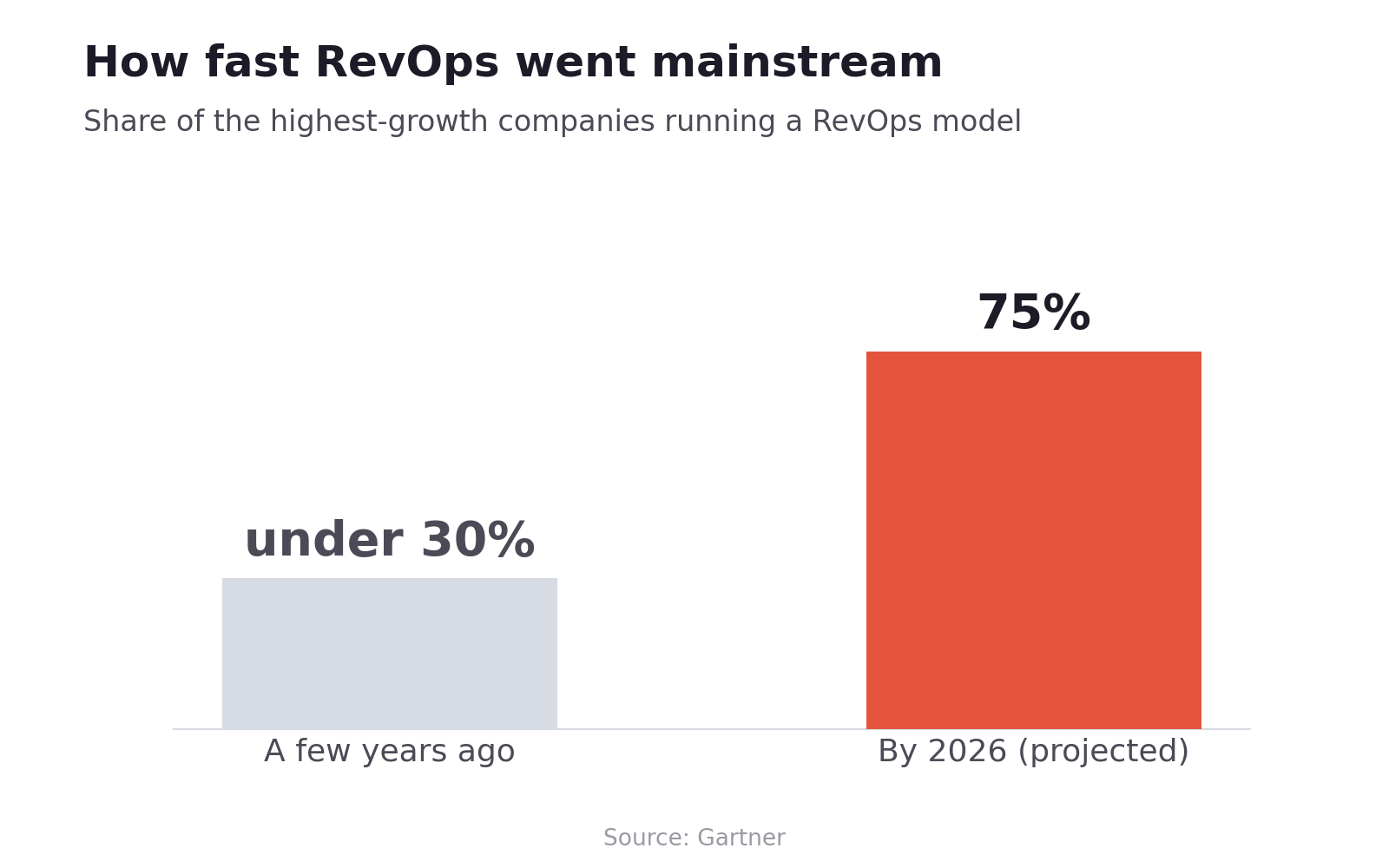
Share of the highest-growth companies running a RevOps model. Source: Gartner.
That’s not a fad curve. That’s a function becoming standard equipment. So let me break the two apart properly, because the difference is worth real money once you see it.
What GTM actually is
GTM, go-to-market, is your bet on the market. It answers the big strategic questions: who you’re selling to, what you’re selling them and how it’s positioned, how you reach them (sales-led, product-led, partner-led, or some blend), how you price and package, and the message that makes a buyer actually care.
When a client tells me “we’re changing our GTM,” they almost never mean they’re tweaking a workflow. They mean they’re moving upmarket, adding a segment, switching from self-serve to sales-assisted, or entering a new country. It’s directional. It’s the answer to “where are we going and how do we win there.”
A real example I worked through last year: a B2B SaaS company that had grown on a freemium, product-led motion suddenly wanted to land six-figure enterprise contracts. That’s a GTM change. Different buyer (a VP instead of an individual user), different sales motion (demos and procurement instead of a credit card), different message (ROI and security instead of “try it free”). None of that is an operational question yet. It’s a strategic decision about who you’re chasing and how you intend to win them.
What RevOps actually is
RevOps is the function that makes the revenue engine run. It owns the systems, the data, the processes, and the reporting that sit underneath marketing, sales, and customer success. The CRM (HubSpot, for most of the companies I work with), the automation, lead routing, lifecycle and deal stages, the handoffs between teams, forecasting, attribution.
If GTM is the plan for the road trip, RevOps is the car. The engine, the dashboard, the fuel lines. Nobody books a vacation excited about fuel lines, but you are not getting anywhere without them.
Back to that same SaaS company. Once they decided to chase enterprise, the RevOps questions started piling up. How do we score and route a sales-qualified lead now that there’s an actual sales team? What does the deal pipeline look like when a cycle takes four months instead of four minutes? How do we stop the enterprise deals from getting buried in the same view as 9,000 free signups? Who gets the lead when both a self-serve user and their boss fill out a form? That’s all RevOps. None of it is strategy. All of it determines whether the strategy survives contact with reality.
This is also why “just have the sales ops person handle it” stops working at a certain size. Gartner has found that sales ops teams spend roughly 68% of their time on work that isn’t directly selling. RevOps exists to take that operational weight off every revenue team at once, not just sales. It’s become enough of a real discipline that RevOps is now one of the fastest-growing job titles around, with well over a hundred thousand open roles floating around the job boards at any given time. The whole point of the function is to kill friction and create predictability: one source of truth, clean handoffs, a forecast you can actually believe, and the ability to answer “what’s working” without a week of spreadsheet archaeology.
The cleanest way to tell them apart
GTM lives in the world of decisions. RevOps lives in the world of execution and measurement.
A GTM question sounds like: “Should we move from SMB into mid-market?”
A RevOps question sounds like: “Our SMB and mid-market deals are sitting in the same pipeline with the same stages, so our forecast is garbage. How do we fix the model?”
Here are a few more pairs, because once you see the pattern it gets easy to sort almost anything:
“Which three industries should we target next quarter” is GTM. “Why does our reporting still bucket those three industries as ‘Other’” is RevOps.
“What’s our pricing for the new tier” is GTM. “Why does a deal closed at the new price still trigger the old onboarding sequence” is RevOps.
“Should marketing own the first sales conversation” is GTM. “Marketing and sales each have their own definition of a qualified lead and the numbers never match” is RevOps.
Both columns matter enormously. One is about where you’re going. The other is about whether your machine can actually take you there and tell you how fast you’re moving.
Why this is worth getting right
This is the part that turns it from a vocabulary lesson into a business case. When companies actually align their people, process, and technology across the full revenue motion, which is exactly what RevOps is built to do, the gap shows up in the numbers. Forrester’s research puts it at around 36% more revenue growth and up to 28% more profitability versus companies that leave those functions siloed.
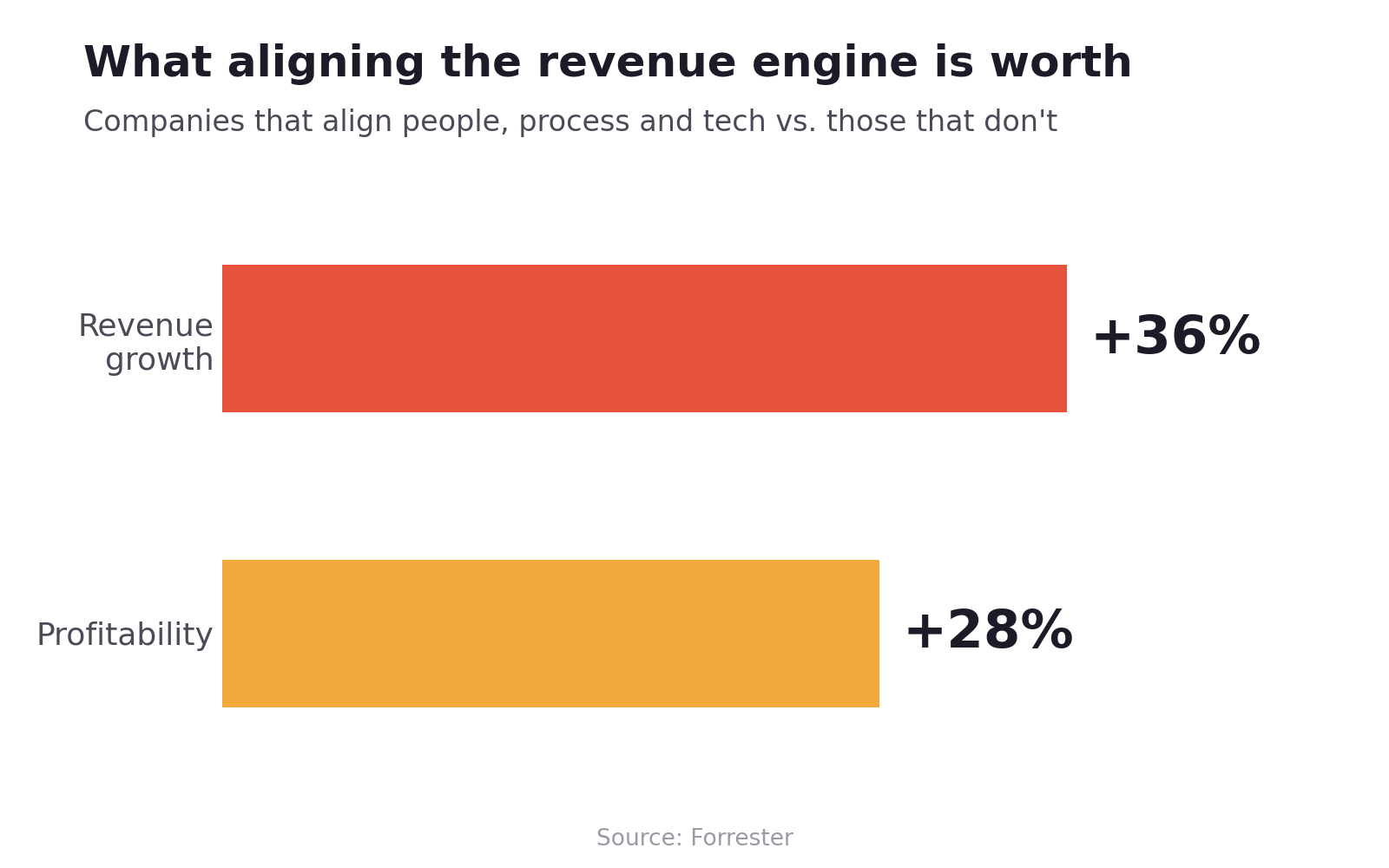
Aligned revenue teams vs. siloed ones. Source: Forrester.
Read that again. Same product, same market, same headcount. The difference is whether the engine underneath the strategy is connected or fragmented. That delta is almost entirely a RevOps story.
Why everyone still mixes them up
Because they bleed into each other constantly. A brilliant GTM strategy is worthless if RevOps can’t operationalize it. And RevOps with no GTM direction is just very tidy data that nobody is using to make a decision. In smaller companies one person (or one agency, hi) often does both at once, so the line gets blurry fast.
The confusion is understandable. But the skills are different, and more importantly, the failure modes are different. A GTM mistake means you’re aiming at the wrong target. A RevOps mistake means you’re aiming at the right target with a scope that’s three degrees off and a trigger that sticks. Different problems, different fixes.
How to know which problem you actually have
This is the part worth bookmarking.
You probably have a GTM problem if the leads coming in are simply the wrong people, your win rate is low because you’re talking to buyers who were never going to buy, your messaging doesn’t land in discovery calls, or you can’t confidently name your single best type of customer.
You probably have a RevOps problem if the leads are right but they fall through the cracks, reps spend half their day updating the CRM by hand, your forecast and reality have never once agreed, marketing and sales report different numbers and both are somehow wrong, deals stall at the same stage every time with no one noticing, or you genuinely cannot answer “where did this customer come from” without opening five tabs.
The expensive trap is treating a RevOps problem as a GTM problem. I see it constantly. A company decides their go-to-market is broken and burns a full quarter rebuilding positioning, hiring a brand consultant, and rewriting the website. Then we look under the hood and the real issue was that inbound leads were sitting unrouted for three days because the assignment workflow quietly broke during a HubSpot migration nobody finished. New strategy, same broken plumbing, same result. They changed the map when the engine was the thing leaking.
It runs the other way too, just less often. I’ve watched a team obsess over a flawless lead-routing setup and a beautiful attribution dashboard while ignoring the fact that almost none of those leads were a fit in the first place. Perfect operations, perfectly tracking the wrong audience. The dashboard was honest. The strategy was the problem.
A quick reality check on where you might be
One more number worth sitting with. RevOps adoption is nowhere near even. Among enterprises it’s basically table stakes now, mid-market is about half in, and small businesses are still mostly figuring it out.
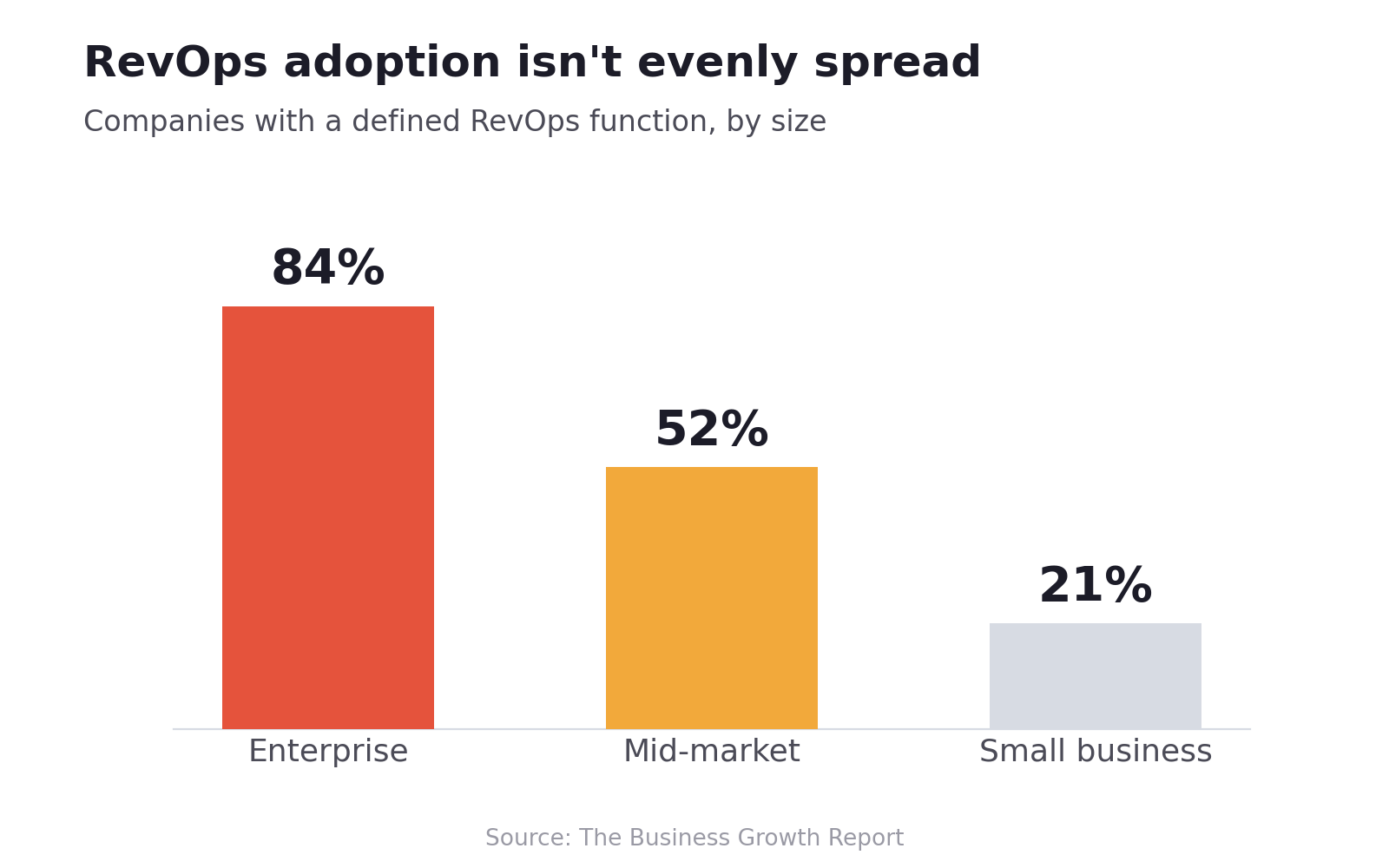
Companies with a defined RevOps function, by size. Source: The Business Growth Report.
If you’re a smaller company, you can read that two ways. As “we’re behind,” sure. But I’d read it as the opposite: the operational discipline that bigger competitors treat as mandatory is still rare in your weight class, which means doing it well is an edge that’s genuinely available to you right now.
They’re partners, not rivals
The healthy setup is genuinely simple. GTM sets the direction. RevOps builds and runs the system that executes it, then feeds the data back so the next GTM bet is smarter than the last one. It’s a loop, not a hierarchy. Your attribution data tells you which segments actually convert, which sharpens your targeting, which changes the strategy, which changes what RevOps has to build next. Around and around.
If you’re a founder, here’s the practical takeaway. You almost certainly own GTM whether you want to or not, because it’s a direct reflection of your strategy and your conviction about the market. Nobody can hold that for you in the early days. RevOps is the part you can systematize, delegate, or bring in help for. And the earlier you treat it as a real function instead of “whoever on the team is least afraid of HubSpot,” the less painful your scaling is going to be.
Get the strategy right and the operations sloppy, and you’ll grow in spite of yourself while bleeding margin and sanity. Get the operations tight and the strategy wrong, and you’ll execute beautifully in the wrong direction. You need both. You just need to stop pretending they’re the same thing.
What’s next on here
I’m not writing this from theory. I’m in the middle of building diiirect.com right now, and over the next few posts I’m going to walk through its actual GTM strategy out in the open. The real one. The segments I’m betting on, the motion I’m choosing and why, the pricing logic, and where I expect the RevOps side to get hard. Not a sanitized after-the-fact case study, but the decisions as I’m actually making them.
If that sounds useful, follow along so you catch it when it drops.
And a quick gut check for your own setup in the meantime: when a great-fit lead comes in, can you trace exactly what happens to it, from first touch to closed deal, without guessing once? If yes, your RevOps is probably solid and any pain you’re feeling is likely strategic. If you flinched reading that, you just found your real problem, and it isn’t your positioning.
That gap is most of what we fix at Draidel. If your pipeline doesn’t add up and you can’t tell which side of this line the trouble is on, that’s the conversation I’m always happy to have.