

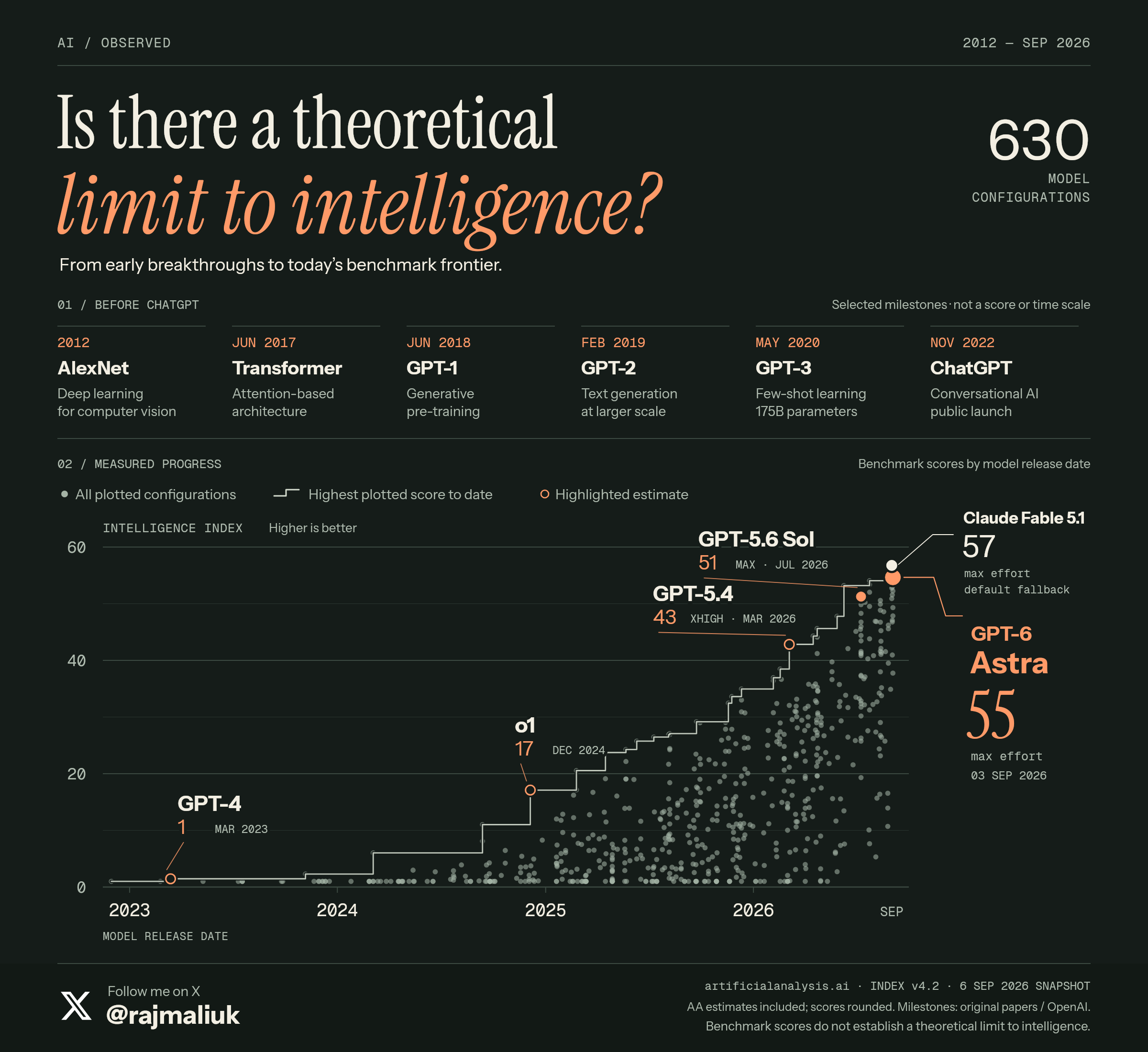
Figure 1. Selected milestones before ChatGPT, followed by 630 plotted model configurations. The benchmark panel uses a September 6, 2026 snapshot, including historical estimates. Sources and reconstruction details appear below.
A rising line invites us to imagine where it ends. Look at the recent history of AI and the temptation is especially strong: models that once struggled with basic instructions now compete on difficult reasoning and coding evaluations. The natural question is whether this progress eventually reaches a ceiling, and how much room remains above us.
My answer is that we should take limits seriously without pretending we know where the ceiling is. Computation has physical constraints. Some problems cannot be solved by any general algorithm. Particular training methods can run into diminishing returns. Yet none of those facts tells us that today’s AI is approaching the maximum useful intelligence a machine could possess.
The more valuable question is which constraint binds next, and whether a better system can work around it. That question gives us something to investigate. A line pointing upward does not.
Here, I use intelligence to mean the ability to learn, reason, and act effectively across a range of tasks. That is a working definition, not a claim that these abilities collapse into a single natural unit. The question of consciousness is separate.
The history begins before the chatbot
The milestone strip above starts in 2012, with AlexNet, a neural network that produced a major result in image recognition. This is a selected history of developments relevant to the present wave, not the beginning of AI. Its importance here is practical: learned representations, large datasets, and substantial computation could outperform more manually engineered approaches on a demanding task. [5]
In 2017, the Transformer introduced an attention-based architecture that dispensed with the recurrent and convolutional structures used in many sequence models. Its original demonstrations concerned machine translation. It allowed more parallelization during training, making it an important part of the engineering foundation for subsequent language models. It was not a proof that scaling would produce unlimited intelligence. [6]
The first GPT paper followed in 2018, pairing generative pre-training with supervised adaptation. GPT-2 arrived in 2019, and GPT-3 in 2020 demonstrated that a sufficiently large language model could perform many tasks from examples supplied in its prompt. GPT-3 had 175 billion parameters; its significance was the breadth of behavior that could be elicited without separately fine-tuning the model for every task. [7, 8, 9]
ChatGPT’s public launch in November 2022 then made conversational interaction accessible to a much wider audience. The interface and the training that supported instruction following mattered alongside the underlying model. A change in how people could use AI became a major event in how they perceived its capabilities. [10]
This history complicates the idea of a single smooth intelligence curve. Progress has involved changes in architecture, data, training objectives, interfaces, and the amount of computation spent on an answer. A timeline identifies when these developments happened. It does not measure their contributions on one common scale.
What the chart actually measures
The lower panel plots 630 model configurations from a September 6, 2026 snapshot of Artificial Analysis. A configuration can be a particular reasoning setting of a model, so 630 is not a count of distinct model families. The horizontal axis is model release date. The vertical axis is the Artificial Analysis Intelligence Index, a composite evaluation rather than a measure of human IQ. [1, 2]
The suite is primarily text-based and in English. A comparison on it is informative, but it cannot represent every form of competence, language, or environment in which a system might operate. [2]
In that snapshot, GPT-6 Astra at maximum reasoning effort scores 55. Claude Fable 5.1 at maximum effort with default fallback scores 57. These are rounded scores for specified configurations, not a claim that either system is superior on every task. A model name alone leaves out part of what was evaluated. [3, 4]
The historical values also need care. The figure uses a common version of the index, v4.2, including Artificial Analysis estimates for older models, placed at their release dates. It is a retrospective comparison. It is not a collection of the scores each model received under the benchmark that existed when it launched.
That is why GPT-4 can appear near the bottom of this much harder index without having been almost unintelligent in 2023. Nor does a score of 55 against a score near 1 imply fifty-five times as much intelligence. The index is not a ratio scale with that interpretation.
There is another subtlety in the graphic: the line shows the highest plotted score available by each date. It cannot fall, because it retains earlier records. That is useful for seeing advances at the frontier, but its upward direction is partly a property of its construction. The dots reveal the much broader spread of models beneath it.
The chart supports a meaningful, bounded conclusion: recent configurations perform substantially better on this evaluation framework than earlier ones. Establishing an acceleration rate would require more than inspecting the curve. We would need stable measurement, attention to uncertainty and evaluation budgets, and an explicit model of the trend. Extrapolating an ultimate ceiling requires still stronger assumptions.
A rising curve does not identify its destination
Imagine observing a technology for only the steep middle of its development. One explanation is that growth will continue. Another is that we are approaching the flat part of a saturation curve. A third is that the current method will slow down and a different method will carry progress forward.
All three can be consistent with the same recent observations. The disagreement is about what happens outside the observed range.
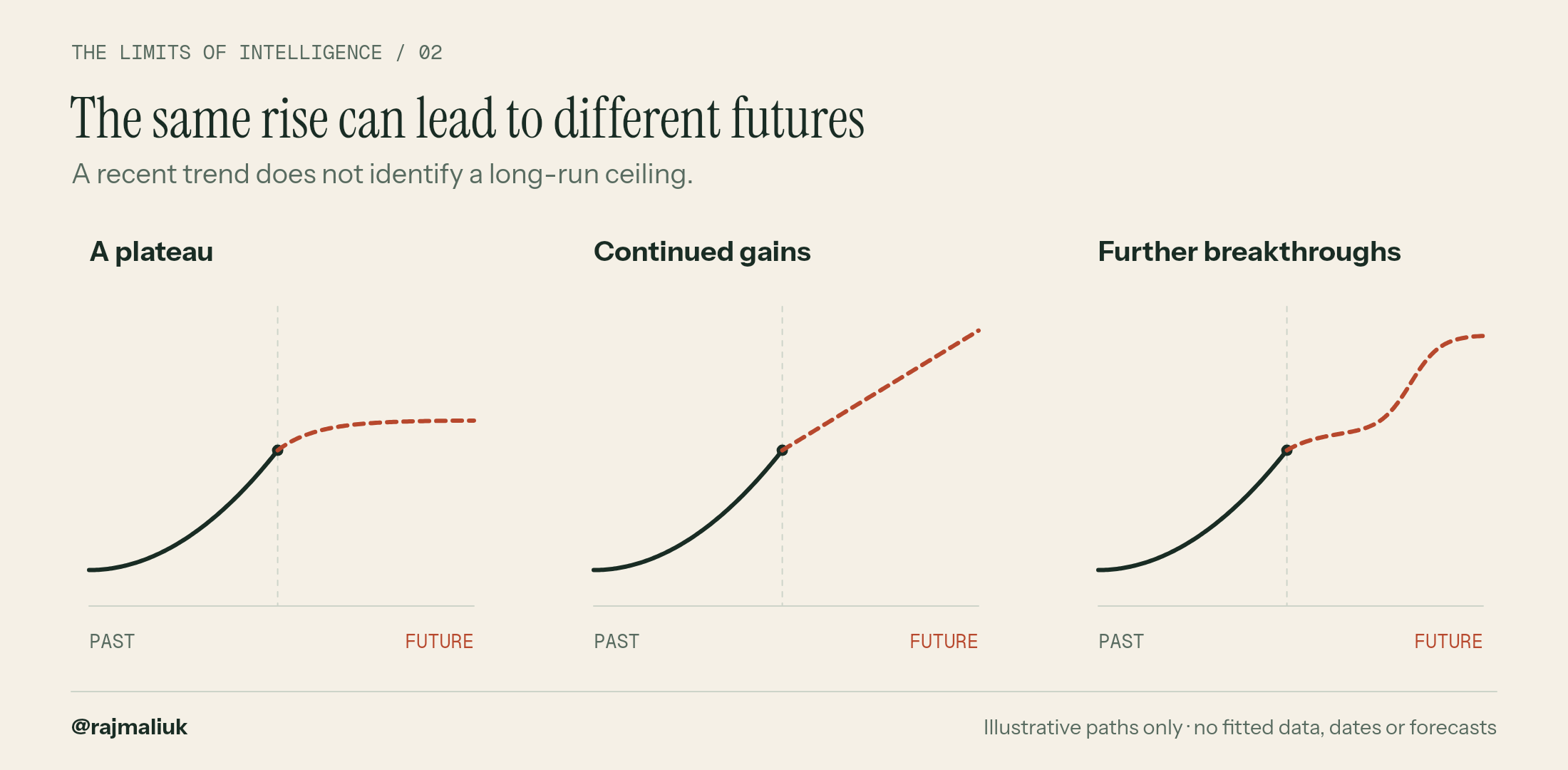
Figure 2. Three illustrative capability paths share the same past and diverge afterward. Horizontal position represents time and vertical position represents capability. These are conceptual scenarios, without numerical scales or forecast probabilities.
This is a problem of inference, not a reason to dismiss progress. Good forecasts make their assumptions visible. If a forecast depends on more compute, it should say how much. If it depends on better algorithms, it should explain what would count as evidence of that improvement. If it assumes a ceiling, it should identify the mechanism that creates it.
Benchmark design adds another complication. Schaeffer, Miranda, and Koyejo showed that some apparently abrupt emergent abilities can arise from the choice of metric: a thresholded score can make gradual underlying changes look sudden. Their result does not establish that every new capability is an illusion. It does show why the shape of a plotted line is not, by itself, a theory of what is happening inside a model. [18]
Scaling laws describe a regime of progress
The case for expecting further improvement is stronger than a collection of impressive demonstrations. Kaplan and colleagues found empirical relationships between language-model prediction loss and model size, data, and training compute. Within the regimes they studied, these relationships made aspects of progress predictable. [11]
But a scaling law is an empirical relationship under particular conditions. It does not say that multiplying compute will produce an unlimited amount of general intelligence. Prediction loss measures how well a model predicts its data distribution. Its relationship to planning, scientific discovery, or dependable autonomous work must be investigated separately.
The Chinchilla study illustrates why even the engineering recipe can change. Hoffmann and colleagues found that allocating a given training budget to a smaller model trained on more data could outperform much larger models. Their 70-billion-parameter Chinchilla outperformed the 280-billion-parameter Gopher across a broad set of evaluations while using the same training compute budget. The allocation of resources mattered, not just the parameter count. [12]
There is also computation at the moment of use. A system can search over candidate answers, revise a solution, or use a verifier to choose among alternatives. Snell and colleagues studied how allocating this test-time computation could improve performance, with the effective strategy depending on the problem and the base model. Additional inference is a resource that can sometimes substitute for other resources; it is not a guarantee of improvement on every question. [13]
This distinction matters when reading a leaderboard. A higher score may reflect more expensive deliberation, better training, or both. A capability curve against release date can rise while the cost of achieving the next increment rises too. For someone trying to use the system, capability at a fixed budget is often the more consequential curve.
Physical limits are real but they are not a leaderboard ceiling
An AI system runs on physical hardware. It has finite memory, a finite energy supply, communication delays, and limited time. In his work on the ultimate physical limits of computation, Seth Lloyd derives bounds on computation from the physical properties of a system. More software cannot make a particular piece of matter perform an arbitrarily large amount of computation in a fixed interval. [14]
Information processing also has thermodynamic consequences. Landauer’s principle concerns the minimum dissipation associated with logically irreversible erasure of information under specified conditions. It is a statement about physical information processing, not a claim that every thought consumes a fixed amount of energy or that every computation must be performed in today’s fashion. [21]
These limits are fundamental. Translating them into a maximum intelligence score requires a model we do not have: a reliable mapping from physical resources to the general capability we care about. Better algorithms can extract more useful work from the same resources. Better representations can make a previously impractical problem manageable. Neither change violates physics.
The limits also depend on what we hold fixed. The maximum work possible for one chip in one second is a different question from the work possible for a distributed system over a year. A claim about a universal ceiling needs to specify the system, its resources, its environment, and the tasks on which it will be judged.
This is why “there are physical limits” and “AI has little room left to improve” are very different claims. The first does not establish the second. A distant physical bound can be real while being a poor guide to the next decade of engineering.
Some questions cannot be solved by adding intelligence
There are limits deeper than the size of a data center. Turing’s work established that there are well-defined computational questions for which no general algorithm can always provide the correct answer. The familiar halting problem asks whether an arbitrary program will eventually stop. No algorithm can decide that correctly for every possible program and input. [15]
A more capable AI may solve many particular cases, recognize useful restrictions, or provide an excellent approximation where approximation makes sense. It does not thereby acquire a universal solution to an undecidable problem. This applies to algorithmic systems regardless of how impressive their conversation becomes.
Undecidability also does not locate a practical intelligence ceiling. A machine can fail to solve every possible mathematical problem while becoming dramatically better at the problems people actually encounter. The space between today’s performance and universal perfection is enormous, and universal perfection is not a necessary condition for transformative capability.
Information is another constraint. If two possible worlds produce exactly the same evidence available to a system, no amount of cleverness can guarantee distinguishing them from that evidence alone. Sometimes the right next step is an observation, an experiment, or a question. Intelligence can improve how efficiently we obtain information; it cannot substitute for all missing information.
The nearer constraints concern feedback and reliable work
The practical bottleneck may be much more ordinary than a physical bound: finding out whether an answer is correct.
AlphaGo Zero is instructive. It learned strong Go play through self-play without using human game records as training examples. That demonstrates, in a restricted domain, that a system need not be limited to reproducing the quality of the human examples it is given. It also benefited from a clear environment, legal moves, and an unambiguous result. A game supplies feedback that many real-world problems do not. [16]
Generating more text is not automatically equivalent to obtaining more knowledge. Shumailov and colleagues demonstrated failures that can arise when generative models are trained recursively on model-generated data. Those results warrant care about data provenance and preservation of the underlying distribution; they do not show that all synthetic data is useless. Verified solutions, simulations, and feedback from external reality are different from repeatedly accepting a model’s untested output as truth. [17]
Long tasks introduce another problem: errors accumulate. Consider a deliberately simple model of a workflow. It has 100 steps, each step succeeds independently with the same probability, and any failure ruins the result. At 99 percent reliability per step, the probability of completing all 100 is only about 36.6 percent. At 99.9 percent, it is about 90.5 percent.
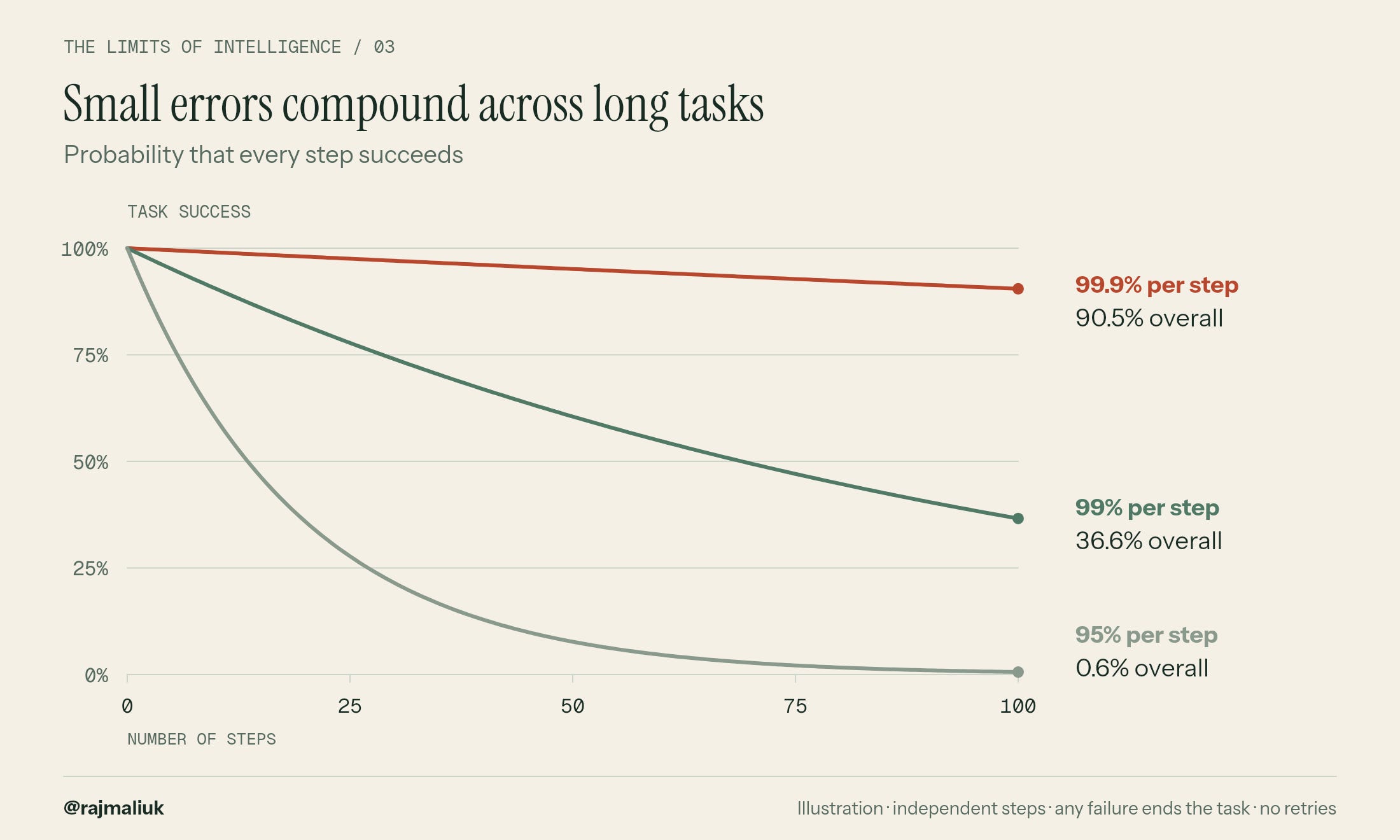
Figure 3. An original calculation of complete-task success as per-step reliability raised to the number of steps. At 100 steps, reliability of 95%, 99%, and 99.9% per step produces about 0.6%, 36.6%, and 90.5% complete-task success. Assumptions: independent equal-reliability steps, no retries, and failure of any step ends the task.
Actual workflows have dependencies, variable difficulty, retries, and opportunities to recover. These numbers are an illustration, not an evaluation of Astra or any other model. Their value is to show why a small change in local reliability can produce a large change in what can be delegated end to end.
System design matters here. Checkpoints, tests, external memory, constrained actions, and human review can change the consequences of individual errors. A more capable deployed system may be built around a model that has barely moved on a general benchmark. Conversely, a higher-scoring model can remain difficult to trust on a long sequence of consequential actions.
For practical purposes, the relevant unit of intelligence is often the entire working system: model, tools, memory, verification, and the people who set its objectives. Comparing a naked model with an expert supported by a laboratory, colleagues, and a library is not an especially informative test of what either can achieve.
Economic progress needs its own evidence
Even success on a task does not settle whether using AI was worthwhile. We have to count the time spent specifying the work, checking it, repairing errors, and integrating the result. The useful denominator is the cost of an accepted outcome, including supervision, rather than the cost of producing an answer.
METR’s study of experienced open-source developers makes this distinction concrete. In a randomized experiment involving 16 developers and 246 tasks on familiar repositories, access to early-2025 AI tools increased completion time by about 19 percent. That was evidence about a particular group, tool generation, and workflow, not a verdict on all AI-assisted programming. [19]
The follow-up is equally important. In February 2026, METR reported that its later experiment had become difficult to interpret because of selection effects, including developers declining to work without AI. The researchers thought greater speedups were likely, but said the new data was an unreliable measure of the current effect. Citing the original slowdown as a permanent law would miss both technological change and a changing measurement problem. [20]
The lesson is to test the system in the work it is meant to improve. A benchmark, a developer’s impression, and a controlled productivity study answer different questions. Disagreement among them is useful evidence about where the bottlenecks are.
What would change my mind
I would become more confident that substantial headroom remains if systems improve on fresh, independently checked tasks while using the same or fewer resources. I would put particular weight on longer workflows completed at high reliability, with less corrective labor from people. Those results would show that improvements are surviving contact with work outside the test itself.
Evidence of an important plateau would look different: persistent diminishing gains across several methods, on fresh evaluations, after controlling for compute, data quality, inference budget, and assistance. A plateau on one saturated exam, or the failure of one training recipe, would be weaker evidence. And a higher headline score obtained by spending far more on each answer would not, by itself, refute an economic plateau.
For anyone evaluating the next model release, I would ask four questions:
Does the improvement hold on unfamiliar tasks that were not used to tune the system?
How much does it cost to obtain a correct, usable result, including checking and repair?
How long can it work at the reliability the application actually requires?
Does the gain come from the model, additional computation, tools, or human assistance?
These questions do not require a prediction about the date of superintelligence. They make the evidence for progress more interpretable now.
The answer depends on the limit we mean
There are firm reasons to reject omniscience. Physical systems have resource constraints, general algorithms cannot solve every well-defined problem, and missing evidence cannot always be reasoned into existence. There is much less justification for treating the current generation of AI, or human performance, as a demonstrated maximum of useful capability.
My working view is that we should expect a succession of constraints. Some will yield to better engineering. Others will demand new methods or new information. Some may prove enduring. The existence of the last category does not tell us when the earlier ones will stop yielding.
That leaves a demanding standard for both optimism and skepticism. Optimism needs evidence that capabilities transfer into reliable, affordable work. Skepticism needs to identify the constraint that further advances cannot overcome. Neither is well served by treating a benchmark curve as a prophecy.
The chart tells us that a particular frontier has moved. Finding out how far it can move means studying the obstacles ahead, one by one.
Follow me on X at @rajmaliuk for more on AI capability and the systems built around it.
Figure methodology
Figure 1 uses the September 6, 2026 Artificial Analysis v4.2 snapshot. Its 630 points were reconstructed from the publicly displayed chart coordinates; release dates were snapped to the nearest day and displayed scores rounded. Historical scores include AA estimates. Hollow highlighted points denote estimates. The frontier is the running maximum across all plotted configurations, not a fitted growth curve. Earlier milestones are contextual and have no assigned index values. Figures 2 and 3 are original illustrations: Figure 2 contains no forecast, and Figure 3 calculates the probability that every step succeeds under the stated independent-step assumption.
References
[1] Artificial Analysis (2026). AI Trends. Chart snapshot September 6 2026.
[2] Artificial Analysis (2026). Intelligence Benchmarking Methodology. Intelligence Index v4.2.
[3] Artificial Analysis (2026). GPT-6 Astra (max) Intelligence, Performance and Price Analysis.
[4] Artificial Analysis (2026). Claude Fable 5.1 (Max Effort, Default Fallback).
[5] Krizhevsky, A., Sutskever, I., and Hinton, G. E. (2012). ImageNet Classification with Deep Convolutional Neural Networks.
[6] Vaswani, A., et al. (2017). Attention Is All You Need.
[7] OpenAI (2018). Improving language understanding with unsupervised learning.
[8] OpenAI (2019). Better language models and their implications.
[9] Brown, T. B., et al. (2020). Language Models are Few-Shot Learners.
[10] OpenAI (2022). Introducing ChatGPT.
[11] Kaplan, J., et al. (2020). Scaling Laws for Neural Language Models.
[12] Hoffmann, J., et al. (2022). Training Compute-Optimal Large Language Models.
[13] Snell, C., Lee, J., Xu, K., and Kumar, A. (2024). Scaling LLM Test-Time Compute Optimally can be More Effective than Scaling Model Parameters.
[14] Lloyd, S. (2000). Ultimate physical limits to computation. Nature 406, 1047–1054.
[15] Turing, A. M. (1936). On Computable Numbers, with an Application to the Entscheidungsproblem. Original paper.
[16] Silver, D., et al. (2017). Mastering the game of Go without human knowledge.
[17] Shumailov, I., et al. (2024). AI models collapse when trained on recursively generated data.
[18] Schaeffer, R., Miranda, B., and Koyejo, S. (2023). Are Emergent Abilities of Large Language Models a Mirage?.
[19] METR (2025). Measuring the Impact of Early-2025 AI on Experienced Open-Source Developer Productivity. July 10 2025.
[20] METR (2026). We are Changing our Developer Productivity Experiment Design. February 24 2026.
[21] Bérut, A., et al. (2012). Experimental verification of Landauer’s principle linking information and thermodynamics.